Showing posts with label WESSA. Show all posts

Tuesday, November 30, 2010

Eco-Schools (LOVE)


One of the most exciting things I was able to find in my time in South Africa was the Eco-Schools Programme, an international awards program for environmental management, certification, and sustainable development in schools, clubs and education centers. It is overseen by the Foundation for Environmental Education (FEE) in Europe, and implemented in South Africa by WESSA, so in my short time volunteering with them I was able to get a glimpse into this wonderful program. As a whole-hearted, vehement supporter of environmental education in every shape and form, I think Eco-Schools is exactly the kind of program that should be in schools around the world; and frankly, that's the direction they're headed: as of October 2009, the program was being implemented in 47 countries around the world, involving 30,000 schools, 8 million students, 400,000 teachers and 4,000 local authorities (according to Eco-Schools USA). The U.S. is a new-comer to the program, hosted by the National Wildlife Federation since December 2008, with about 380 participating schools. South Africa has been involved in Eco-Schools since 2003, and has nearly 1,150 schools participating.

Here's an overview of how the program works, according to the Evaluation of the Eco-Schools South Africa Programme, prepared by Eureta Rosenberg on behalf of WESSA, WWF-SA and C.A.P.E. (Cape Action for People and the Environment):

In South Africa, schools which register with the Programme must:
· Audit environmental conditions and resource use at their school
· Implement projects to improve their environmental conditions and resource use
· Conduct environmental education lessons; and
· Report annually on their progress to the Eco-Schools coordinators, who convene panels of experts to assess the schools’ work.
Lessons can be conducted in any subject and topics include wise use of resources, habits for healthy living, and caring for each other and the earth. Popular projects in rural and urban areas are food gardens, bringing back indigenous biodiversity, wetland - or soil rehabilitation, recycling and measures to conserve water and energy. Each environmental improvement must be maintained, even as new ones are introduced in subsequent years of registration.
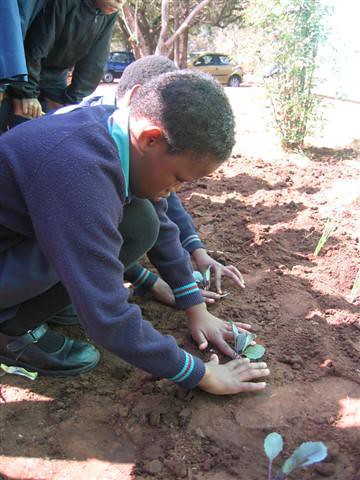

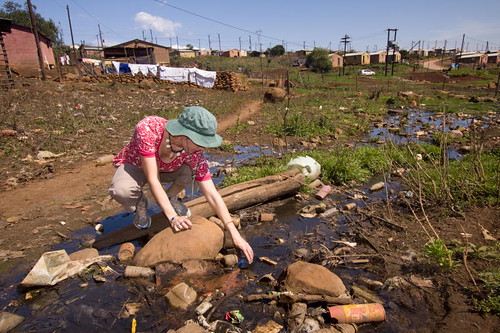
I had the opportunity to help evaluate some of the Eco-Schools portfolios to help determine whether they merited an award for their work throughout the year, and I was really impressed by the efforts some of these schools were making toward environmental sustainability and awareness. One small, rural school I evaluated had done a project focused around a river which ran alongside their school. The water from this river was gathered by some people for drinking or cooking, but women also washed clothes in it and some students were spotted using it as a toilet, while pollution and litter were inhibiting the water's flow and causing stagnancy. Teachers in the school recognized the health risks the current state of the river could cause to the students, wildlife and the whole community, and they decided to use the Eco-Schools program to do something about it. The students took a field trip to the river and worked together with teachers to identify pollutants and their sources, then determine ways to reduce pollution and rehabilitate the river and its habitats. They incorporated lessons in biology, math, health and other subjects to take an interdisciplinary approach to the problem, and then the students took what they learned home to their parents, and as a result to the whole community. This becomes so much more than a school lesson or a quick project by a few community members: it spreads awareness and reform through the entire community and makes real, tangible change a possibility.
That's what really makes me excited about the Eco-Schools program: it teaches environmental education through practice. It shows students, schools and the community that taking steps to help the environment actually helps themselves, by saving money, improving health, and allowing them to become more self-sustaining. It encourages students and teachers to undertake projects themselves, giving them ownership and increasing the likelihood that the projects will continue for years to come. It requires commitment and drive from all those involved, but has really amazing benefits for those who are willing to do the work.

Wednesday, November 10, 2010

The Journey to WESSA

Images: Above: Map of East London. Source: http://sa-venues.com.
Below: the Boxer taxi rank. Source: http://brabysproperty.co.za


Within a few days of emailing WESSA I received a message back from Catherine Andersson, their project manager for environmental education, saying that she’d be interested in meeting me. We set up a date and I went about finding the way to Beacon Bay, where their office is located. For this I was able to use the expertise of Matt, who was here last year and was one of our teachers for the prep course. He used to stay in Beacon Bay, so he knew its taxi system well, and sent me a really helpful Google Map with stops labeled. I plotted out my route from the nearest stop to the WESSA office, about a 20 minute walk, and went through the whole route on the map until I was sure I could work it. Just in case any of you ever need to find your way from Devereux to WESSA, I’m going to take you through the step-by-step directions. You can also follow along on the Google Map.

1. Leave the house a couple hours before your appointment. Walk from home to Devereux street, wait until you see a taxi or hear one honking and point toward town (to the right). Listen for them to yell “Townie.” If they say “Mdantsane,” it’s going the other way. Don't get on that one.
2. When one pulls over, hop in. You may have to give the mamas a chance to shift over if it’s one of the smaller taxis; just squash in alongside them.
3. Pass up 6 rand to the yeller if you’re in a van or the driver in a car. It’s best to have exact change. If you’re in the back, just tap the person in front of you and they’ll pass your change forward.
4. The taxi takes you along Oxford Street. A couple streets before Gladstone, around City Hall, call out “Absa 2” or “2nd Absa,” and they’ll stop at the corner of Gladstone, next to an Absa bank. Cross Oxford and head down Gladstone until you find a store called Boxer, surrounded by taxis going in all directions. This is the Boxer taxi rank.
5. Right across from the Boxer there’s a parking lot with a few rows of taxis. If you stand there for a moment, someone will ask you where you’re headed, or you can just go up to one of the men who are yelling and pointing authoritatively. Tell him Bonza, Bonza Bay, or Beacon Bay (or a combination of the three until he gets what you mean), and he’ll point you where you need to go. It should be the van nearest the street. Jump in and hope it fills quickly. Avoid the vendors trying to sell you sweets, sunglasses and cell phones.
6. Once the taxi starts moving pass up your 6 rand, then just enjoy the trip. You’ll cross the Buffalo River, which is nice. When you’ve been going for a good while the caller or driver will ask something about Pick n Pay or Spargs, and you’ll want to say Spargs. Keep your eyes open for a retail park or mall with the sign that says Spargs, with a Super Spar inside it. This is your stop.
7. Cross the street to Spargs then continue in the direction you were driving until you reach Beaconhurst, then turn right.
8. Walk a while. This is a relatively quiet residential area, so you may feel uncomfortable after spending so much time on Oxford and Devereux. Just try to relax and enjoy the walk.
9. Turn left on Blue Bend road, and you’ll see the sign for WESSA, within the Nahoon Estuary Nature Reserve, which is called the Dassie Trail by most locals. Tell the people at the booth that you’re going to WESSA and you won’t have to sign in. You’ve arrived!

My meeting with Catherine went very well. I immediately felt at home in her office, surrounded by environmental messages and recycling bins. Unfortunately most of their activities are finished for the year, since schools were busy with exams, but she had a few things I could become involved with, including assessments of the Eco-Schools portfolios. She also got me in touch with Jakob and Paula, two young German volunteers who are working on setting up an environmental club at Inkwenkwezi High School in Mdantsane. I left very happy, but again wishing that I’d found WESSA sooner.

Tuesday, November 9, 2010

Discovering WESSA

Image credit: www.wessa.org.za

I was walking through VP one day, minding my own business, when I saw a glowing radiance in front of me, in the form of a booth that WESSA, the Wilderness and Environment Society of South Africa, had set up. It was covered with beautiful posters and pamphlets about environmental education, stewardship, alternative energy, ecosystems, green efforts . . . all the things I love the most. I stood for a few minutes just admiring the booth and soaking up all its environmental goodness, so proud of VP for holding something so beautiful and wonderful, then gathered up a variety of newsletters and pamphlets from the table and set out to enjoy them. This is when I learned about all the great conservation efforts that WESSA is involved with, including the Eco-Schools Programme, which encourages and helps to fund environmental education and sustainability programs within local schools. I had no idea that such a thing existed here in South Africa, but I immediately decided that I wanted to get involved. So I stopped off at the internet across from VP and emailed the local chapter of WESSA to show my interest, then went to their website to find out more.

As it turns out, WESSA has been around since 1926, and has the vision "to achieve a South Africa which is wisely managed by all to ensure long-term environmental sustainability" (www.wessa.org.za). They're involved in all kinds of projects from wetland protection to beach clean-ups to environmental education, and produce publications for adults and children which spread environmental awareness and give ways to get involved with community actions. It really is a wonderful organization. They're not small, either: there are 52 WESSA branches across South Africa, the nearest one in Beacon Bay, which is in East London just past Nahoon. This is exactly the kind of organization I'd been looking for since before I arrived in South Africa, and it just makes me so happy to know that one really exists, and has an office so close to where I stay. I only wish that I'd found them earlier.