Showing posts with label marketing. Show all posts

Tuesday, November 30, 2010

Experience through Wordle

Wordle: Experience Africa
I've compiled all the text from 26 randomly chosen travel brochures I picked up in gas stations, tourist information centers and park offices from East London to Cape Town and put them into a Wordle to show the most common words found in these brochures. The big winner? 'Experience,' which was used 45 times in these 26 brochures. This was closely followed by 'game,' at 41. Some other top scorers: Africa (27), African (21), safari (22), unique (20), free (19), forest (15), nature (14), enjoy (13), wild (13), wildlife (12), great (12), and conservation (11). The top animals were elephant (17), cheetah (15) and ostrich (14).

This is a very small sampling of brochures, even out of my own collection, but I did find it interesting that the top word was Experience. They're not advertising just to see or do things, but to experience them. There is also clearly an emphasis on game and nature based tourism, which greatly dominate the mainstream South African tourism industry.

I'm sure there must be a way to make this Wordle image bigger without it looking blurry, but it's not working for me. If someone knows the trick, please share. As is, you can click on it to see the full-size image.

Monday, November 29, 2010

Take Only Pictures, Leave Only Footprints


In my perusal of Aidan's collections I paid special attention to nature brochures, and found a number from the 1970s or '80s advertising nature reserves. Two carried the tag-line "take only pictures, leave only footprints," which I've found in a number of modern pamphlets and brochures, including one for the Nahoon Estuary Nature Reserve ("take only pictures and memories, leave only footprints") and which is even mentioned in my Ecotourism and Sustainable Development textbook by Martha Honey as a "catchy phrase" often used in "mainstream ecotourism" or "ecotourism lite" (page 62). These kinds of phrases invoke a feeling of preservation and of having a low impact, but without actually committing to anything specific. It brings up a common issue that arises in nature tourism, which is distinguishing between the organizations and facilities that sound green and responsible, and those that actually are. This doesn't mean that all organizations using these "catchy phrases" should be immediately mistrusted - the Nahoon Estuary has done a really great job, for instance - but they also shouldn't be immediately labeled as shining examples of sustainability. I'm going to address this issue more fully in a future post.

I kept my eyes open for anything that might be classified as ecotourism in Aidan's collection, but other than some "ecotourism lite" like that mentioned above I didn't see anything. The emphasis on community benefit, involvement and empowerment which is so essential to ecotourism is something that even today can be difficult to find in marketing materials, and environmental effects and efforts beyond general nature conservation (which is essential for the survival of nature tourism) can be difficult to determine.

One booklet that caught my interest went into detail about a nature reserve's battles for conservation, their failures due to poor management, and their final victory through a collaboration of scientists, managers and community members. What it described was the same kind of environmental challenge being faced today by many natural areas in South Africa and around the world: struggles against development and poor land use, political battles for funding and recognition, fights to save endangered species and diminished/diminishing habitats, and efforts to get the community to care and to become involved. It's encouraging to know that East London was already taking such strides for conservation so many years ago, but it's also a bit discouraging to see how many of these same problems are faced today, and how many remain without solutions.

Wednesday, November 24, 2010

Aidan: A Link to the Past

Image source: http://metromediasa.com. This is a 1925 image of Orient Beach, which is adjacent to Eastern Beach. You can find more pictures like this at their website. I was unable to find any online images from the 1950s like the one I've described below.
Image 2: Eastern Beach in 1907
Image 3: a man selling candy on the esplanade above Eastern Beach. Source: blogs.dispatch.co.za
Image 4: Eastern Beach in 2008. Source:
ilsebatten, flickr.com

I found Aidan one day when I was sitting in Wendy's Book Lounge, reading, writing and talking to Cornelius as I so often do. Cornelius introduced me as one of his girls, as he always does, and Aidan and I started talking about my research. As it turns out, Aidan is quite involved in the nature tourism industry: his family owns a tour operation in the northern part of the country and he's put considerable effort into following what's happening in it, and is even looking into starting some sort of a tour company of his own. We talked while he browsed the shelves around us: about how the Eastern Cape has a lot of under-utilized potential for tourism; how there's a lack of continuity between areas of the province, left over from the Apartheid-era homeland separation; and how the marketing in the Eastern Cape just hasn't been as effective as in other parts of the country. He also brought up the issue of safety, how many people still have misgivings about traveling to South Africa because of its reputation of being dangerous and crime-ridden -- though if you just take the right precautions, he says, it can be as safe as anywhere else. He had a lot to say and clearly could say more, so he told me I could stop by some day and talk to him again.

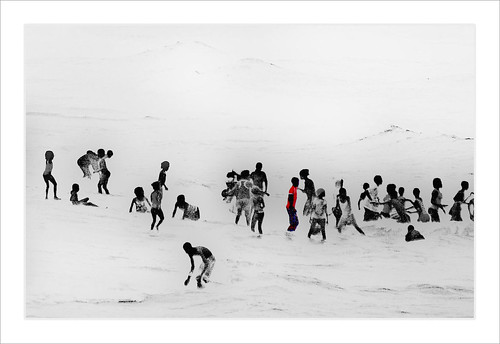
A week later I was able to go to Aidan's home to talk to him further, along with Diana, who had met Aidan independently, and wanted to see his collection of old postcards of Oxford Street. He invited us right into his home and introduced us to his wife and two children, the older of whom was 10, about my sister's age. Diana and I were offered tea and muffins as Aidan went into the back to find us what might interest us in his collections. He came back with books and boxes full of postcards and business information for Diana and travel brochures for me. These were really fascinating: pamphlets and brochures from the 70s, 50s and earlier, advertising East London and the surrounding area. The brochures for EL itself displayed a city drastically different from the one I've gotten to know so well. One brochure that looked as though it must have been from around 1950 gushed about the thousands of tourists that visited the city each year, drawn by what they termed "the safest beaches in the southern hemisphere," the "charming, bustling downtown," and the overall "family-friendly atmosphere." The pictures showed Orient and Eastern Beaches, beaches I've visited many times, covered with beach towels, umbrellas, and bikini-clad sunbathers, next to waters filled with laughing children and their proud and watchful parents. I wonder what those people would think if they were to see these places today. Eastern Beach is often covered with people, but they're mostly local and all black, except for the occasional white surfer or tourist from Sugarshack Backpacker's. This beach gives off the immediate sense of a party: everyone laughing and yelling, laying on the sand just in front of the surf and waiting for the waves to bowl them over, dressed in whatever they have at hand - jeans and t-shirts, dresses, underwear, once in a while an actual swimsuit. Tell-tale bottles and cans are typically strewn across the sand and boardwalk, signs of the last night's revelry and a preview for the upcoming evening. It's loud and eager and invigorating and alive, but certainly not the tame, tourist- and family-friendly site of 60 years ago. And not at all white like those picture-perfect families on the brochure.

I was also intrigued by the claims these brochures made about East London being a tourist hot-spot and favorite vacation destination for travelers from all over the world. Unless they were greatly exaggerating EL's popularity, something must have happened to take this city off the map. Or maybe nothing happened, and that's the problem - it just didn't keep up with the modernization and marketing happening in other parts of the country, and with nothing new or unique to offer, it eventually lost its draw. Now I'm curious to see the numbers for East London tourism. I've already tried to find them online to no avail, so I'll have to try emailing the tourism information office and see if they have anything to tell me.

Monday, November 1, 2010

The Sublime and Ecotourism

Images: Above: A B&B at Hogsback, South Africa. Source: aatravel.co.za
Image 2: Some of the South African nature-based tourism brochures I've collected.
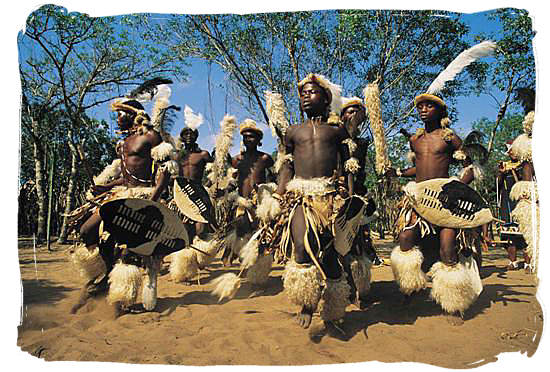
Image 3: Young Zulus performing a traditional Zulu warrior dance. Source: south-africa-tours-and-travel.com


I have long been using this blog to explore the topics of ecotourism and the sublime individually, but have until now put little effort into connecting the two, though the connections are engrained into the very essence of ecotourism. The elements that define the sublime in nature – seclusion, Otherness, vastness, astonishment – are exactly the components that are offered, at least in theory, by ecotourism. This brand of travel offers access to remote, pristine natural places which have not been developed or degraded by the hand of man, accompanied by the promise that they never will meet such a fate. Essentially, it offers the sublime: immense distance from the familiar, physical and mental escape from the complexity and drudgery of everyday life, and the opportunity to experience an ancient, untamed and untamable world. The ecotourist expects experiences rivaling those of Joseph Conrad, Ernest Hemingway, Percy Shelley and other great travel writers: true adventure, filled with the excitement of novelty and discovery. The reality may not be quite as romantic as these expectations, but in theory, this is exactly what ecotourism offers.

Promotional materials for nature tourism and ecotourism draw on gently sublime imagery like that found in historical travel writing, using phrases such as “tranquil mountain surroundings” (Botlierskop Day Safaris), “breathtakingly beautiful” (Aquila Safaris), “unspoilt nature” (Nahoon Estuary Nature Reserve), “largest wilderness on earth” (Schotia Safaris), "unbelievably dramatic view" ("The Edge" Mountain Retreat) and “pilgrimage through time” (Cango Caves). Bhejane Adventures goes further by offering that imagery in the experience itself: “the Knysna forests conjure images from well read stories, of phantom elephants, wood-cutters, Italian settlers and lost travelers.” It goes on to say that the forest “has been off-limits to anybody . . . Bhejane Adventures has obtained the exclusive rights to take small groups of people . . . into the last remaining sections of the Knysna forests.” Martha Honey gave a similar example of the Cruise Company of Greenwich, which advertised “a visit to unknown lands, in this case in one of Costa Rica’s largest national parks: ‘The Corcovado area is so remote, inaccessible, and undisturbed that even most Costa Ricans have never visited.’ The notion that cruise ship passengers will machete their way through Corcovado’s dense, steep, and rain-drenched tropical forest is ludicrous, but the image is appealing” (Who Owns Paradise, 62). The tourist wants to experience something unique, authentic and as far from civilization and modern life as they can get; and in this distance, they have the chance to find that natural sublime that can only exist in such remote areas.

Although the advertising for these kinds of tours and experiences are often exaggerated, the conditions of ecotourism do provide an ideal setting for the sublime. Ecotourism requires the preservation of a natural area’s integrity, emphasizing the importance of leaving no impact on the environment. This means that the conditions are kept as pristine as possible, with less visible influence from man, and smaller numbers of people are allowed into vulnerable areas at one time, to minimize their negative impact. This allows the traveler to find greater seclusion and more authentic, unadulterated nature than in other forms of nature travel. Ecotourism’s inclusion of local culture can also encourage a sense of the sublime Other in the tourist. People are drawn by cultures that are distinctly different from their own, and especially enjoy seeing those that appear to be living pre-modern lifestyles, without modern technology and with a greater connection to nature. Not only does this give them that sense of separation and seclusion from the familiar that can facilitate the sense of the sublime, but it excites Romantic notions about the woes of industrialization and our loss of natural purity, which encouraged the original turn after the Industrial Revolution to the natural and sublime by Romantic poets. Thus cultural preservation becomes profitable to local people, encouraging them to resist Westernization or at least put on displays of traditional culture, which attracts greater tourist attention. When surrounded by a culture that seems rooted in an ancient past and by nature that has resisted any human impact, the tourist is taken far away from the familiar, and with the realization of their separateness and lack of control, and without the distractions of technology and modernity, they have the possibility of experiencing the sublime.