Showing posts with label sublime. Show all posts

Tuesday, November 30, 2010

The Sublime and Ecotourism: Richard Bangs


Apparently I'm not the only one who's been making connections between ecotourism and the sublime. Richard Bangs, an old man who's called "the father of modern adventure travel" by www.smarttravels.tv/adventure.htm, has produced a TV series called Adventures with Purpose in conjunction with KCTS (the Seattle PBS station I grew up with), and in one segment of this show he traveled to Switzerland in search of the sublime. Though I'm a little bitter that he stole my idea shortly before I came up with it, this trailer is a nice overview of the sublime side of ecotourism. He even brings in Percy Shelley, who I quoted months ago in my exploration of the sublime. I'd be interested to see the whole video.

Monday, November 1, 2010

The Sublime and Ecotourism

Images: Above: A B&B at Hogsback, South Africa. Source: aatravel.co.za
Image 2: Some of the South African nature-based tourism brochures I've collected.
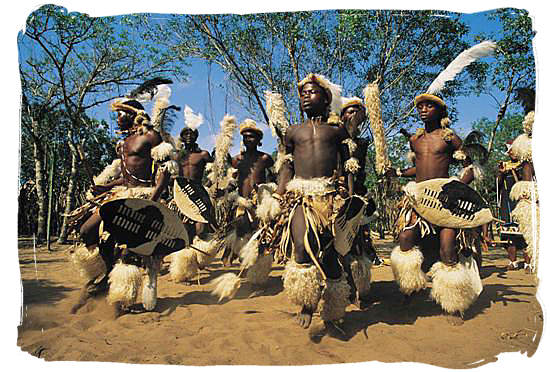
Image 3: Young Zulus performing a traditional Zulu warrior dance. Source: south-africa-tours-and-travel.com


I have long been using this blog to explore the topics of ecotourism and the sublime individually, but have until now put little effort into connecting the two, though the connections are engrained into the very essence of ecotourism. The elements that define the sublime in nature – seclusion, Otherness, vastness, astonishment – are exactly the components that are offered, at least in theory, by ecotourism. This brand of travel offers access to remote, pristine natural places which have not been developed or degraded by the hand of man, accompanied by the promise that they never will meet such a fate. Essentially, it offers the sublime: immense distance from the familiar, physical and mental escape from the complexity and drudgery of everyday life, and the opportunity to experience an ancient, untamed and untamable world. The ecotourist expects experiences rivaling those of Joseph Conrad, Ernest Hemingway, Percy Shelley and other great travel writers: true adventure, filled with the excitement of novelty and discovery. The reality may not be quite as romantic as these expectations, but in theory, this is exactly what ecotourism offers.

Promotional materials for nature tourism and ecotourism draw on gently sublime imagery like that found in historical travel writing, using phrases such as “tranquil mountain surroundings” (Botlierskop Day Safaris), “breathtakingly beautiful” (Aquila Safaris), “unspoilt nature” (Nahoon Estuary Nature Reserve), “largest wilderness on earth” (Schotia Safaris), "unbelievably dramatic view" ("The Edge" Mountain Retreat) and “pilgrimage through time” (Cango Caves). Bhejane Adventures goes further by offering that imagery in the experience itself: “the Knysna forests conjure images from well read stories, of phantom elephants, wood-cutters, Italian settlers and lost travelers.” It goes on to say that the forest “has been off-limits to anybody . . . Bhejane Adventures has obtained the exclusive rights to take small groups of people . . . into the last remaining sections of the Knysna forests.” Martha Honey gave a similar example of the Cruise Company of Greenwich, which advertised “a visit to unknown lands, in this case in one of Costa Rica’s largest national parks: ‘The Corcovado area is so remote, inaccessible, and undisturbed that even most Costa Ricans have never visited.’ The notion that cruise ship passengers will machete their way through Corcovado’s dense, steep, and rain-drenched tropical forest is ludicrous, but the image is appealing” (Who Owns Paradise, 62). The tourist wants to experience something unique, authentic and as far from civilization and modern life as they can get; and in this distance, they have the chance to find that natural sublime that can only exist in such remote areas.

Although the advertising for these kinds of tours and experiences are often exaggerated, the conditions of ecotourism do provide an ideal setting for the sublime. Ecotourism requires the preservation of a natural area’s integrity, emphasizing the importance of leaving no impact on the environment. This means that the conditions are kept as pristine as possible, with less visible influence from man, and smaller numbers of people are allowed into vulnerable areas at one time, to minimize their negative impact. This allows the traveler to find greater seclusion and more authentic, unadulterated nature than in other forms of nature travel. Ecotourism’s inclusion of local culture can also encourage a sense of the sublime Other in the tourist. People are drawn by cultures that are distinctly different from their own, and especially enjoy seeing those that appear to be living pre-modern lifestyles, without modern technology and with a greater connection to nature. Not only does this give them that sense of separation and seclusion from the familiar that can facilitate the sense of the sublime, but it excites Romantic notions about the woes of industrialization and our loss of natural purity, which encouraged the original turn after the Industrial Revolution to the natural and sublime by Romantic poets. Thus cultural preservation becomes profitable to local people, encouraging them to resist Westernization or at least put on displays of traditional culture, which attracts greater tourist attention. When surrounded by a culture that seems rooted in an ancient past and by nature that has resisted any human impact, the tourist is taken far away from the familiar, and with the realization of their separateness and lack of control, and without the distractions of technology and modernity, they have the possibility of experiencing the sublime.
Saturday, October 16, 2010

Sublime South Africa: Hogsback and Cape Point

Photo credit: Britt Smith

My second brush with the South African sublime, after Nahoon, was in Hogsback, a portion of the Amathole mountains. Driving up the rough road to the trail I planned to hike, the trees on either side of me were leaning in almost as though they wanted to reclaim the road for the forest, and I realized that that was exactly what they were someday going to do. Men can clear trees, build roads and structures, and attempt to control all aspects of nature, but in the end none of it can last. Tree roots break through cement or asphalt, new plants grow up in the cracks, and with time all evidence of the road will be covered with fresh soil and life. Considering the war we are constantly waging against nature with our factories, pollution, buildings and machines, it is incredible that so much of it still survives with such perfection, not fighting but simply existing, strong in its own will and rightness. Hogsback is one of those places that fill you with absolute peace and tranquility, because unlike the city, these forests belong here, and they are exactly as they should be: eternal, self-renewing, and perfectly balanced. As much as we like to think it does, no land can ever belong to us like it does to itself, and Hogsback makes that clear. Walking in that majestic, powerful forest made me realize just how separate nature can be from ourselves, how outside of our control, and how indifferent to us. These mountains don’t care about me and my friends, or about the city nearby. It has itself figured out, and it runs perfectly without any outside help or intervention. I think the sense of the sublime that I felt in this place came from the recognition that no matter what we may do, we can’t affect the spirit of this forest, and no matter how hard we try, we can’t replicate the perfect balance and serenity that exists here. It is the world exactly as it’s intended to be.

The third was simpler, but no less sublime. At Cape Point, I found the most beautiful views I had ever seen, from the sharp cliffs directly beside me to the rough African coastline extending in the distance and the expansive ocean surrounding me on three sides. It was just perfect and beautiful and immense, and the air was sharp and fresh and invigorating, and it was hard to believe that something like this could just exist, but there it was. It was sublime because it was wonderful, one of those places that, once you've seen it, is always somewhere in the back of your mind.

Sublime South Africa: Nahoon

The passion caused by the great and sublime in nature, when those causes operate most powerfully, is Astonishment; and astonishment is that state of the soul, in which all its motions are suspended, with some degree of horror. In this case the mind is so entirely filled with its object, that it cannot entertain any other, nor by consequence reason on that object which employs it.
-Edmund Burke, "On the Sublime and the Beautiful"

At the Nahoon Point Nature Reserve the sublime sense I felt was aided by the information I found in the reserve’s visitor’s center. Here I read about the millions of years of life and death collected in the cliffs at Nahoon, the evidence of ancient creatures and humans embedded in the rock which had once been sand. A few minutes later, standing on those cliffs and imagining all of the years and lives that were collected into every inch of stone, and looking out into the ocean, focusing on the distant point where the sky and ocean seem to meet, but knowing that they both continue on, I couldn’t help relating the time and life collected beneath me to that constant and endless ocean and sky: so much happening in every square inch at every second, but all blended into this great, unreachable, forever blue-on-blue. It was a very powerful and overwhelming experience, one that made me feel tiny and insignificant, but also somehow greater because of my tie to this incomprehensible vastness, a vastness that I still can’t reason through and clearly can’t describe. I think that's the passion Burke described, where "the mind is so entirely filled with its object, that it cannot entertain any other, nor by consequence reason on that object which employs it."

Finding a South African Sublime

The passion caused by the great and sublime in nature, when those causes operate most powerfully, is Astonishment; and astonishment is that state of the soul, in which all its motions are suspended, with some degree of horror. In this case the mind is so entirely filled with its object, that it cannot entertain any other, nor by consequence reason on that object which employs it.
-Edmund Burke, On the Sublime and Beautiful

In the early days of this blog I put considerable time and effort into my exploration of the sublime, looking at the various definitions of the concept, discovering ways others have experienced and described it in writing and media, and drawing connections between the sublime described in Romantic-era literature and the idea of the modern, technological sublime. Now I’ve had the opportunity to explore the sublime in a physical sense, through my travel to truly sublime locations in South Africa, while at the same time looking at how this concept relates to my project on ecotourism. In my next few blog posts I’m going to focus on these sublime experiences and connections, beginning with my experiences at Nahoon, Hogsback and Cape Point.