Wednesday, December 1, 2010

Stylistic Imitations: Conrad


In Heart of Darkness, Joseph Conrad proves himself a master of creating intense moods through his strong imagery and detailed descriptions. In this way he's able to drag the reader into the Heart of Darkness the title refers to: both the literal depth of the jungle and the figurative darkness at the heart of Mr. Kurtz. I took a short passage from this novel and closely imitated it for two different situations. I enjoy this kind of imitation, though it was difficult to get the same single-minded direction Conrad achieved while combining separate images like this.

Original: from Heart of Darkness by Joseph Conrad, page 14.
A narrow and deserted street in deep shadow, high houses, innumerable windows with venetian blinds, a dead silence, grass sprouting between the stones, imposing carriage archways right and left, immense double doors standing ponderously ajar. I slipped through one of these cracks, went up a swept and ungarnished staircase, as arid as a desert, and opened the first door I came to.

Imitation 1 (Oxford Street taxi):
A rickety and crowded taxi in a busy street, dirty windows, seats filled with sweating bodies, a jarring racket, groceries crammed beneath the seats, fat laughing mamas on every side, cracked windows introducing blessedly breathable air. Another man ducked through the open doorway, struggled past the obstructive and vocal occupants, as immovable as the seats themselves, and squeezed into the largest space he could find.

Imitation 2 (Near Nahoon Beach):
A wide and smooth beach in bright sunlight, clear water, expansive sky without a cloud, a stinging wind, shells scattered across the sand, confident gulls strutting just out of reach, barely visible footprints pensively shifting shape. I stepped into one of these footprints, followed its fellows on a winding and hurried path, as unpredictable as the surf, and sought the child who had walked there.

Stylistic Imitations: Hemingway


Another author whose style I experimented with in my writing was Ernest Hemingway, after reading his journal/memoir Green Hills of Africa. In this book Hemingway often employs a somewhat rambling stream-of-consciousness, creating a meshing of his actions, the setting around him, and the thoughts or emotions he has to create one emotive portrait of a scene. The following passage is an example of this from page 58 of Green Hills of Africa.

So in the dark, following this ideal line, we descended into steep ravines that showed only as wooded patches until you were in them, slid down, clung to vines, stumbled and climbed and slid again, down and down, then steeply, impossibly, up, hearing the rustle of night things and the cough of a leopard hunting baboons; me scared of snakes and touching each root and branch with snake fear in the dark. To go down and up two hands-and-knee-climbing ravines and then out into the moonlight and the long, too-steep shoulder of mountain that you climbed one foot up to the other, one foot after the other, one stride at a time, leaning forward against the grade and the altitude, dead tired and gun weary, single file in the moonlight across the slope, on up and to the top where it was easy, the country spread in the moonlight, then up and down and on, through the small hills, tired but now in sight of the fires and on into camp.

Again I didn't closely imitate this particular passage, but I did try to implement some of the same stylistic methods Hemingway used in my post The Trouble With Africa, especially in the portion below:

Though the city may disguise them, the big open spaces are here as well. Drive six kilometers to the beach and you’ll find yourself on giant cliffs embedded with ancient life, coated with recent life, crawling with new life, overlooking huge untamable waves crashing in from an endless blue ocean which, far in the distance, touches an equally endless, arching blue sky. Drive an hour inland through the dry, cow-spotted fields and you’ll find yourself suddenly surrounded by a thousand shades of green, climbing over immense moss-covered boulders beside towering waterfalls, staring toward ghostly canopies floating in a near-impenetrable mist, becoming engulfed by the hums and clicks and warbles and shrieks and croaks and drips and whoops that create the symphony of the forest, feeling small and foolish standing there with your worn tackies and half-filled pack and diminishing fantasy that you could conquer all this greatness, realizing the indifferent acceptance and quiet invitation that the land offers you and losing the feeling of self-importance with which you entered the forest.
I'm not sure that the resemblance is very clear, but my stylistic inspiration for this post was definitely Hemingway. This is a style I like a lot; I have a lot of fun with long, multi-directional sentences and the liberal use of commas and semicolons. The image is part of the scene in Hogsback that I was trying to describe in this passage, photographed by Britt Smith when we were hiking there together. It's really an incredible place, which I described more in another post.

Stylistic Imitations: Chatwin

As part of my Travel Writing course, I've been experimenting with different styles of writing and recording experiences, partly through imitations of the literature I've been reading. One of the first books I attempted to imitate was Bruce Chatwin's What am I Doing Here, a collection of Chatwin's various travel experiences. The interesting thing about this collection is that Chatwin expresses his experiences through the conversations and interactions he has with people: very heavy on dialogue and description but without a lot of his own thoughts or impressions, thus leaving the reader to come to his/her own conclusions based on Chatwin's observations and dialogue. Rather than choosing a specific passage to imitate, I took that dialogue-rich and personal commentary-free style Chatwin uses to record a number of my own experiences and interactions in South Africa. The first of these was Conversations, my first post in East London, in which I recorded a few of my initial interactions with South Africans. At the time, it had seemed extremely strange and almost unsettling to me that total strangers, who I didn't know and didn't expect to see again, were so immediately friendly and talkative. It was these conversations with strangers, and even the fact that strangers were having conversations with me, that really stuck with me from that first day. This was also my first experience with Africa Time: Diana had an appointment with Rachel at nine, which at nine (when we arrived) was moved to eleven, then we had time to hear the life story of a random man in Rachel's office before she was actually ready to see us. She wasn't being rude, she was just busy with other people too. That flexibility with time and schedules was something that took some getting used to.

I used this style again to about the same effect in the first half of my post on Friends and Sindiwe Magona, where I recorded a conversation with the owner of the cafe Friends. I ended up going back there a number of times. Also, interestingly enough, this conversation was also the result of a last-minute schedule change. Coincidence?

The final Chatwin-esque post I wrote was Library Boys, about some boys who came to talk to me one day in the library. This conversation had a lot of really interesting elements to it that I thought were worth drawing attention to: themes that I encountered daily, and that I think say a lot about South African culture. First was the obvious fact that I stood out wherever I went, as a white American, which motivated these boys to talk to me in the first place. Then the unending friendliness of everyone, and their eagerness to make conversation, no matter how inappropriate it may seem in a given setting or situation (like a library). The language barrier was there as well, something I had to wrestle with daily, and conversely the impressive multilingualism of many South Africans: this boy spoke 4 languages fluently (I met another young man from Zimbabwe who spoke 6: 5 African tongues and English, with plans to tackle Afrikaans next). Two more subtle elements to this conversation were the racial awareness that is always there in South Africa - this boy explained to me that he was coloured without my asking, as he considered it an important enough part of his identity that he included it in even this casual introduction - and the concern that people always expressed for my safety, especially when I was traveling in non-white areas of town (as he left he told me to be careful on the public taxis). To have all these elements thrown into this conversation without accompanying analysis and explanation I think is a far better representation of the way they exist in the cultural context of South Africa. Things like the racial awareness are constantly there, but not in such a way that it's shocking or calling attention to itself - it's just there and it feels natural.

The difficult thing with writing in Chatwin's style was the dialogue. I haven't used dialogue in my writing since my last creative writing course in 7th grade, and it's far more difficult than I expected. I had a very hard time making the conversations sound natural, and it was impossible to capture the unique accents and different ways of speaking that these people had. It would be much easier if I could say, "Read with a black South African accent, strong fluency in English" or "Read with a British white South African accent" before each line. I certainly have a new appreciation for writers of novels and other dialogue-rich literature.

Tuesday, November 30, 2010

The Sublime and Ecotourism: Richard Bangs


Apparently I'm not the only one who's been making connections between ecotourism and the sublime. Richard Bangs, an old man who's called "the father of modern adventure travel" by www.smarttravels.tv/adventure.htm, has produced a TV series called Adventures with Purpose in conjunction with KCTS (the Seattle PBS station I grew up with), and in one segment of this show he traveled to Switzerland in search of the sublime. Though I'm a little bitter that he stole my idea shortly before I came up with it, this trailer is a nice overview of the sublime side of ecotourism. He even brings in Percy Shelley, who I quoted months ago in my exploration of the sublime. I'd be interested to see the whole video.

Experience through Wordle

Wordle: Experience Africa
I've compiled all the text from 26 randomly chosen travel brochures I picked up in gas stations, tourist information centers and park offices from East London to Cape Town and put them into a Wordle to show the most common words found in these brochures. The big winner? 'Experience,' which was used 45 times in these 26 brochures. This was closely followed by 'game,' at 41. Some other top scorers: Africa (27), African (21), safari (22), unique (20), free (19), forest (15), nature (14), enjoy (13), wild (13), wildlife (12), great (12), and conservation (11). The top animals were elephant (17), cheetah (15) and ostrich (14).

This is a very small sampling of brochures, even out of my own collection, but I did find it interesting that the top word was Experience. They're not advertising just to see or do things, but to experience them. There is also clearly an emphasis on game and nature based tourism, which greatly dominate the mainstream South African tourism industry.

I'm sure there must be a way to make this Wordle image bigger without it looking blurry, but it's not working for me. If someone knows the trick, please share. As is, you can click on it to see the full-size image.

Eco-Schools (LOVE)


One of the most exciting things I was able to find in my time in South Africa was the Eco-Schools Programme, an international awards program for environmental management, certification, and sustainable development in schools, clubs and education centers. It is overseen by the Foundation for Environmental Education (FEE) in Europe, and implemented in South Africa by WESSA, so in my short time volunteering with them I was able to get a glimpse into this wonderful program. As a whole-hearted, vehement supporter of environmental education in every shape and form, I think Eco-Schools is exactly the kind of program that should be in schools around the world; and frankly, that's the direction they're headed: as of October 2009, the program was being implemented in 47 countries around the world, involving 30,000 schools, 8 million students, 400,000 teachers and 4,000 local authorities (according to Eco-Schools USA). The U.S. is a new-comer to the program, hosted by the National Wildlife Federation since December 2008, with about 380 participating schools. South Africa has been involved in Eco-Schools since 2003, and has nearly 1,150 schools participating.

Here's an overview of how the program works, according to the Evaluation of the Eco-Schools South Africa Programme, prepared by Eureta Rosenberg on behalf of WESSA, WWF-SA and C.A.P.E. (Cape Action for People and the Environment):

In South Africa, schools which register with the Programme must:
· Audit environmental conditions and resource use at their school
· Implement projects to improve their environmental conditions and resource use
· Conduct environmental education lessons; and
· Report annually on their progress to the Eco-Schools coordinators, who convene panels of experts to assess the schools’ work.
Lessons can be conducted in any subject and topics include wise use of resources, habits for healthy living, and caring for each other and the earth. Popular projects in rural and urban areas are food gardens, bringing back indigenous biodiversity, wetland - or soil rehabilitation, recycling and measures to conserve water and energy. Each environmental improvement must be maintained, even as new ones are introduced in subsequent years of registration.


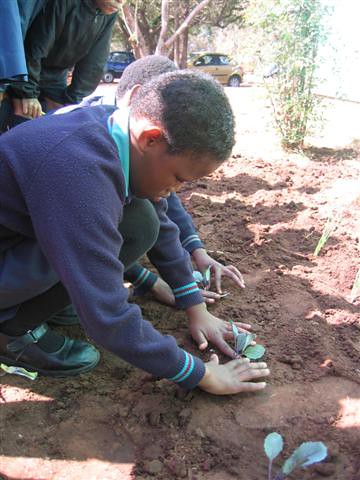
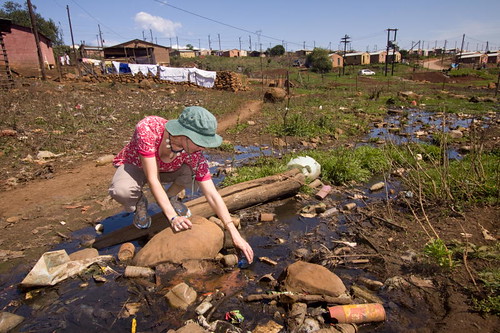
I had the opportunity to help evaluate some of the Eco-Schools portfolios to help determine whether they merited an award for their work throughout the year, and I was really impressed by the efforts some of these schools were making toward environmental sustainability and awareness. One small, rural school I evaluated had done a project focused around a river which ran alongside their school. The water from this river was gathered by some people for drinking or cooking, but women also washed clothes in it and some students were spotted using it as a toilet, while pollution and litter were inhibiting the water's flow and causing stagnancy. Teachers in the school recognized the health risks the current state of the river could cause to the students, wildlife and the whole community, and they decided to use the Eco-Schools program to do something about it. The students took a field trip to the river and worked together with teachers to identify pollutants and their sources, then determine ways to reduce pollution and rehabilitate the river and its habitats. They incorporated lessons in biology, math, health and other subjects to take an interdisciplinary approach to the problem, and then the students took what they learned home to their parents, and as a result to the whole community. This becomes so much more than a school lesson or a quick project by a few community members: it spreads awareness and reform through the entire community and makes real, tangible change a possibility.

That's what really makes me excited about the Eco-Schools program: it teaches environmental education through practice. It shows students, schools and the community that taking steps to help the environment actually helps themselves, by saving money, improving health, and allowing them to become more self-sustaining. It encourages students and teachers to undertake projects themselves, giving them ownership and increasing the likelihood that the projects will continue for years to come. It requires commitment and drive from all those involved, but has really amazing benefits for those who are willing to do the work.

Monday, November 29, 2010

Take Only Pictures, Leave Only Footprints


In my perusal of Aidan's collections I paid special attention to nature brochures, and found a number from the 1970s or '80s advertising nature reserves. Two carried the tag-line "take only pictures, leave only footprints," which I've found in a number of modern pamphlets and brochures, including one for the Nahoon Estuary Nature Reserve ("take only pictures and memories, leave only footprints") and which is even mentioned in my Ecotourism and Sustainable Development textbook by Martha Honey as a "catchy phrase" often used in "mainstream ecotourism" or "ecotourism lite" (page 62). These kinds of phrases invoke a feeling of preservation and of having a low impact, but without actually committing to anything specific. It brings up a common issue that arises in nature tourism, which is distinguishing between the organizations and facilities that sound green and responsible, and those that actually are. This doesn't mean that all organizations using these "catchy phrases" should be immediately mistrusted - the Nahoon Estuary has done a really great job, for instance - but they also shouldn't be immediately labeled as shining examples of sustainability. I'm going to address this issue more fully in a future post.

I kept my eyes open for anything that might be classified as ecotourism in Aidan's collection, but other than some "ecotourism lite" like that mentioned above I didn't see anything. The emphasis on community benefit, involvement and empowerment which is so essential to ecotourism is something that even today can be difficult to find in marketing materials, and environmental effects and efforts beyond general nature conservation (which is essential for the survival of nature tourism) can be difficult to determine.

One booklet that caught my interest went into detail about a nature reserve's battles for conservation, their failures due to poor management, and their final victory through a collaboration of scientists, managers and community members. What it described was the same kind of environmental challenge being faced today by many natural areas in South Africa and around the world: struggles against development and poor land use, political battles for funding and recognition, fights to save endangered species and diminished/diminishing habitats, and efforts to get the community to care and to become involved. It's encouraging to know that East London was already taking such strides for conservation so many years ago, but it's also a bit discouraging to see how many of these same problems are faced today, and how many remain without solutions.